Section outline

    • Welcome to Designing Clinical Research (DCR), Summer/Fall One-Month Version, Tracks 1, 2, and 3

      This one-month course is designed to introduce you to the core concepts and skills necessary to design and interpret clinical research studies and develop a protocol for your own research project. During the course, you will complete assigned readings, watch video lectures, participate in interactive small group discussion sections, and gradually write a 5-page protocol that provides the roadmap for conducting your own clinical research study.

      In this syllabus (please pay attention to the different Track dates), you will find instructions for completing readings, watching video lectures, and working on your protocol assignments during each week and module of the course. These activities are designed to complement your participation in twice weekly, interactive, small group discussion sections involving 6 to 9 other students, facilitated by a trained section leader. In these small groups (conducted primarily by Zoom this year), you will discuss important course concepts and receive feedback that will help you write and revise your protocol assignments, while simultaneously providing feedback to other students about their own research.

      This fast-paced, intensive course covers a lot of material in a short amount of time, but at the end you will have an important tool for designing and carrying out your research-- a complete protocol can be used to conduct a study or develop a research grant or that provides the framework for your future research manuscript.

    • Course Directors

      Dr. Alison Huang is an internal medicine physician, clinical epidemiologist, and clinical trialist at the University of California San Francisco, where her research focuses on advancing understanding of the impact of aging on urinary and sexual health in women.
      Dr. Megumi Okumura is an internal medicine and pediatric specialist who conducts research to study and formulate interventions that address barriers and facilitators to chronic illness care for children with special health care needs as they transition from the pediatric to adult health care setting.
    • Prerequisites

      All enrollees in this course should have:

      • A viable idea for a clinical research question or project that they have discussed with a mentor who is an experienced investigator.
      • Permission from their program directors to devote ~10 hours per week to this course and related research activities.
      • Experience with word processing software, biomedical literature searching with Pubmed, and reference management software (Endnote, Zotero, or other software).
    • Reading Assignments

      DCR book

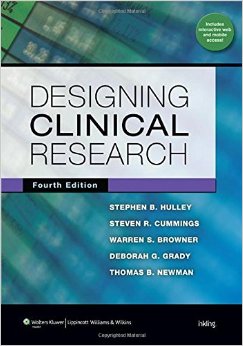
      Required Text: Most reading for this course is from the textbook Designing Clinical Research, 4th edition, by Dr. Stephen B Hulley, MD MPH, Steven R Cummings, MD, Warren S Browner, MD, MPH, Deborah Grady, MD, MPH, and Thomas B Newman MD, MPH

      This textbook can be purchased or rented from Amazon.com. It can also be borrowed from the UCSF Library (in paper-based on electronic formats). It can also be purchased directly from the publisher.

      Other recommended readings and resources are posted on or linked from this on-line course course syllabus in the relevant modules.


    • Technical Requirements

      This year, we will hold video-based small group discussion sections using the UCSF-supported Zoom app/program. Prior to your first section, try to ensure that you have:
      - a Zoom-enabled device, such as a tablet, iPad, laptop, or computer with an embedded or attached camera and microphone
      - a quiet place where you can participate in an interactive Zoom-based section with minimal distractions or disruptions
      - broadband internet access during the times when you need to participate in video-based sections
    • Section Roster

      If you are an enrolled student, please consult the roster below for your section information, including section leader name and meeting access information.
      We ask that you avoid missing more than one section in this course, and that you notify your section leader in advance if you have to be absent.

      Note that this year the course involves different section "tracks," with sections meeting on different dates depending on the track.
      Please confirm that you are using the dates for your assigned track (all section dates are Mondays or Wednesdays, regardless of track).
    • Section Roster for Track 1 (updated 7-28-21) File
      Not available unless: You belong to Registered Student Only
    • Section Roster for Track 2 File
      Not available unless: You belong to Registered Student Only
    • Protocol Assignments

      For each module of this course, students will complete an assignment that focuses on drafting a section of a study protocol that corresponds to the learning objectives, lectures, and readings for that module. Sample complete protocols are available for reference and review. We encourage students to modify and improve all parts of their protocols as they move through the course. Protocol development is an iterative process, and one aim of the course is to help students revise and improve their protocols so the final product can serve as the foundation for conducting a study. 

      Optional Exercises

      Optional exercises provide additional learning opportunities with questions that assess a wide scope of content from the lecture and text. Correct responses are provided with detailed explanations to assist with a deeper understanding of the course content.

      Course Overview

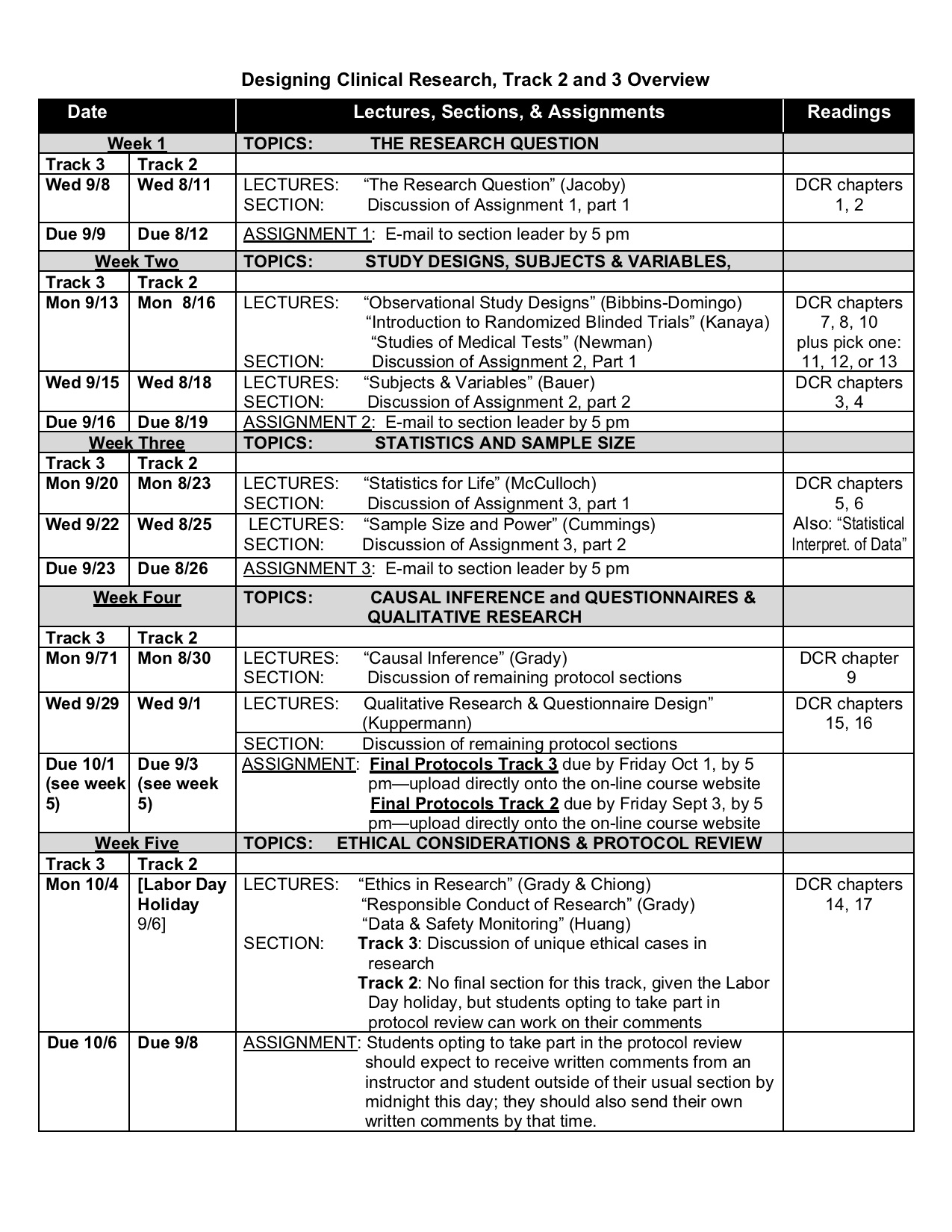
      The table below presents the sequence of topics, lectures, readings, and assignments for each week and module of the course. Note that dates differ for Track 2 versus Track 3. However, both tracks start on a Wednesday (the only module for Week 1) and then follow the same pattern during Weeks 2, 3, and 4 of the course.