Module 1: What Is HIV Test Counseling? Why Is It Important?
| Site: | UCSF Collaborative Learning Environment |
| Course: | Advanced Counselor Skills Pre-Training Course |
| Book: | Module 1: What Is HIV Test Counseling? Why Is It Important? |
| Printed by: | Guest user |
| Date: | Friday, July 17, 2026, 12:13 PM |
Description
Module 1: What is HIV Test Counseling?
Table of contents
- 1. Module 1 Title Screen
- 2. Introduction
- 3. What Is HIV Test Counseling?
- 4. What's the Big Deal?
- 5. Scientists Discover HIV—the Virus that Causes AIDS
- 6. HIV Invades CD4+ Cells
- 7. AIDS
- 8. Information Isn’t Enough to Stop the Spread of HIV
- 9. What HIV Test Counselors Do
- 10. Who Is Most at Risk in California?
- 11. Module Conclusion

Module 1:
What Is HIV Test Counseling?
Why Is It Important?
Module 1: What Is HIV Test Counseling? Why Is It Important? Screen 2 of 11

Introduction
Now that you know how to get around, let’s get started!
This course is an introduction to HIV test counseling.
We’ll show you what HIV test counselors do, and prepare you to participate and be successful in the Basic HIV Counselor Skills Training.
In the course of this online training, we will meet several HIV test counselors and their clients, and watch what happens in actual test counseling sessions.
Introduction
Now that you know how to get around, let’s get started!
This course is an introduction to HIV test counseling.
We’ll show you what HIV test counselors do, and prepare you to participate and be successful in the Basic HIV Counselor Skills Training.
In the course of this online training, we will meet several HIV test counselors and their clients, and watch what happens in actual test counseling sessions.
Module 1: What Is HIV Test Counseling? Why Is It Important? Screen 3 of 12

What Is HIV Test Counseling?
Most clients come into HIV test sites to find out if they are infected with the virus that causes AIDS. We run that test for them, but HIV test counseling includes other elements too:
We need to make sure that each client understands how HIV is transmitted, how HIV transmission can be prevented, and what the HIV test results mean.
Also—and this might be most important—we hope to have a conversation with clients that encourages them to think about HIV prevention in their lives: what they’ve tried before, what works, what doesn’t, and what they might consider doing in the future.
What Is HIV Test Counseling?
Most clients come into HIV test sites to find out if they are infected with the virus that causes AIDS. We run that test for them, but HIV test counseling includes other elements too:
We need to make sure that each client understands how HIV is transmitted, how HIV transmission can be prevented, and what the HIV test results mean.
Also—and this might be most important—we hope to have a conversation with clients that encourages them to think about HIV prevention in their lives: what they’ve tried before, what works, what doesn’t, and what they might consider doing in the future.
Module 1: What Is HIV Test Counseling? Why Is It Important? Screen 4 of 12
 What's the Big Deal?
Most other medical tests don’t come with counseling. Why do we counsel people who come for an HIV test? The answer lies in the history of HIV and AIDS.
As you may know, HIV is a fairly new disease. In 1981, doctors in New York and Los Angeles suddenly realized that otherwise healthy gay men were developing severe immune system problems, including rare types of pneumonia and a skin cancer called Kaposi’s sarcoma. These men, many of them young, became desperately ill and died within weeks or months. No one knew what was causing the illness.
The earliest cases of the disease were nearly all diagnosed among gay men, so it was originally called gay-related immunodeficiency disease (GRID). Before long, injection drug users, people with hemophilia, and others were identified as having the new immune system disease as well, and its name was changed to acquired immune deficiency syndrome (AIDS).
In the beginning, no one knew what caused AIDS or how it was transmitted. There was a lot of panic and terrible prejudice against gay men and others who were infected.
Ask yourself: Can you name 3 important elements of an HIV test counseling session?
If not, reread the last few screens.
What's the Big Deal?Most other medical tests don’t come with counseling. Why do we counsel people who come for an HIV test? The answer lies in the history of HIV and AIDS.
As you may know, HIV is a fairly new disease. In 1981, doctors in New York and Los Angeles suddenly realized that otherwise healthy gay men were developing severe immune system problems, including rare types of pneumonia and a skin cancer called Kaposi’s sarcoma. These men, many of them young, became desperately ill and died within weeks or months. No one knew what was causing the illness.
The earliest cases of the disease were nearly all diagnosed among gay men, so it was originally called gay-related immunodeficiency disease (GRID). Before long, injection drug users, people with hemophilia, and others were identified as having the new immune system disease as well, and its name was changed to acquired immune deficiency syndrome (AIDS).
In the beginning, no one knew what caused AIDS or how it was transmitted. There was a lot of panic and terrible prejudice against gay men and others who were infected.
Ask yourself: Can you name 3 important elements of an HIV test counseling session?
If not, reread the last few screens.
Module 1: What Is HIV Test Counseling? Why Is It Important? Screen 5 of 12
Scientists Discover HIV—the Virus that Causes AIDS
 Three years later, in 1984, scientists in France and the United States discovered that AIDS is caused by a virus. They named it the human immunodeficiency virus (HIV).
Soon after, a blood test was developed to detect HIV infection, and we learned how the virus is transmitted from one person to another. (We’ll review transmission in Module 5).
Ask yourself: Is AIDS caused by a bacterial infection or a virus?
If you’re not sure, reread the last few screens.
Scientists Discover HIV—the Virus that Causes AIDS
Three years later, in 1984, scientists in France and the United States discovered that AIDS is caused by a virus. They named it the human immunodeficiency virus (HIV).Soon after, a blood test was developed to detect HIV infection, and we learned how the virus is transmitted from one person to another. (We’ll review transmission in Module 5).
Ask yourself: Is AIDS caused by a bacterial infection or a virus?
If you’re not sure, reread the last few screens.
Module 1: What Is HIV Test Counseling? Why Is It Important? Screen 6 of 12
HIV Invades CD4+ Cells
HIV is a virus that invades CD4+ cells, which are a critical part of our immune system. Once inside a CD4+ cell, the virus uses the cell to create more virus. In the process HIV destroys the original cell.
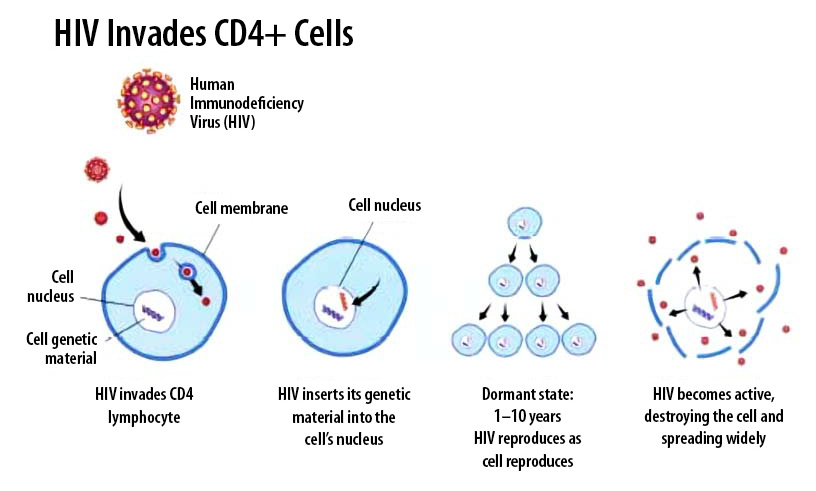
As more and more immune system cells are destroyed, the body has a harder time fighting off both HIV and other illnesses. Illnesses that would not affect people with healthy immune systems take this opportunity to establish themselves. They are called opportunistic infections and conditions. Pneumocystis carinii pneumonia is an example of an opportunistic infection.
HIV Invades CD4+ Cells
HIV is a virus that invades CD4+ cells, which are a critical part of our immune system. Once inside a CD4+ cell, the virus uses the cell to create more virus. In the process HIV destroys the original cell.
As more and more immune system cells are destroyed, the body has a harder time fighting off both HIV and other illnesses. Illnesses that would not affect people with healthy immune systems take this opportunity to establish themselves. They are called opportunistic infections and conditions. Pneumocystis carinii pneumonia is an example of an opportunistic infection.
Module 1: What Is HIV Test Counseling? Why Is It Important? Screen 7 of 12
AIDS

Most people don’t develop immune system problems until many years after they are infected with HIV. Even though they don’t have symptoms, they can infect others with HIV.
When a person with HIV contracts one of the specific AIDS-related opportunistic infections or when their CD4+ cell count falls below 200, a doctor diagnoses AIDS.
Today, medications often can delay or prevent the progression of HIV to AIDS. With proper medical care, many people with HIV are living long and productive lives.
AHP has compiled more information on HIV and AIDS in a PDF that you can download from our Web site:
Frequently Asked Questions in HIV Counseling and Testing
Ask yourself: When does a doctor diagnose AIDS?
If you’re not sure, reread the last few screens.
AIDS
Most people don’t develop immune system problems until many years after they are infected with HIV. Even though they don’t have symptoms, they can infect others with HIV.
When a person with HIV contracts one of the specific AIDS-related opportunistic infections or when their CD4+ cell count falls below 200, a doctor diagnoses AIDS.
Today, medications often can delay or prevent the progression of HIV to AIDS. With proper medical care, many people with HIV are living long and productive lives.
AHP has compiled more information on HIV and AIDS in a PDF that you can download from our Web site:
Frequently Asked Questions in HIV Counseling and Testing
Ask yourself: When does a doctor diagnose AIDS?
If you’re not sure, reread the last few screens.
Module 1: What Is HIV Test Counseling? Why Is It Important? Screen 8 of 12
Information Isn’t Enough to
Stop the Spread of HIV

Once it was clear how HIV was and was not transmitted, there was a huge sigh of relief among medical workers, AIDS activists, and in the communities most affected by the disease. All people needed to do, it seemed, was use condoms and stop sharing needles, and the epidemic would halt.
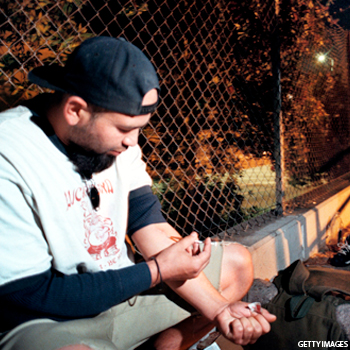 But changing sexual and social behavior is very, very difficult. Many of the communities most at risk for HIV transmission have long histories of oppression and discrimination that make self-care especially challenging. And when the HIV test was first available, there weren’t any of the successful treatments for HIV and AIDS-related complications that exist now. Deciding to test for HIV status was often a difficult choice to make.
In response, AIDS activists and health care workers created an approach to HIV test counseling that combined the medical test with supportive, nonjudgmental counseling about HIV transmission and prevention, as well as about the test itself.
Information Isn’t Enough to
Stop the Spread of HIV
Once it was clear how HIV was and was not transmitted, there was a huge sigh of relief among medical workers, AIDS activists, and in the communities most affected by the disease. All people needed to do, it seemed, was use condoms and stop sharing needles, and the epidemic would halt.
But changing sexual and social behavior is very, very difficult. Many of the communities most at risk for HIV transmission have long histories of oppression and discrimination that make self-care especially challenging. And when the HIV test was first available, there weren’t any of the successful treatments for HIV and AIDS-related complications that exist now. Deciding to test for HIV status was often a difficult choice to make.In response, AIDS activists and health care workers created an approach to HIV test counseling that combined the medical test with supportive, nonjudgmental counseling about HIV transmission and prevention, as well as about the test itself.
Module 1: What Is HIV Test Counseling? Why Is It Important? Screen 9 of 12
What HIV Test Counselors Do

HIV test counselors try to have a nonjudgmental conversation with clients that clarifies the facts about HIV and engages clients in talking about sex and drug use. By focusing on clients' thoughts and feelings, counselors help them think about what they’ve done in the past and might want to do in the future to prevent HIV.
This online course offers the information that forms the foundation for the face-to-face Basic HIV Counselor Skills Training you will be attending soon. Both trainings build on 25 years of experience talking with people about stopping the transmission of HIV.
For more information on the difference between health-related counseling and health education, see this PDF on AHP’s Web site: Comparing Health Education with Client-Centered Counseling
What HIV Test Counselors Do
HIV test counselors try to have a nonjudgmental conversation with clients that clarifies the facts about HIV and engages clients in talking about sex and drug use. By focusing on clients' thoughts and feelings, counselors help them think about what they’ve done in the past and might want to do in the future to prevent HIV.
This online course offers the information that forms the foundation for the face-to-face Basic HIV Counselor Skills Training you will be attending soon. Both trainings build on 25 years of experience talking with people about stopping the transmission of HIV.
For more information on the difference between health-related counseling and health education, see this PDF on AHP’s Web site: Comparing Health Education with Client-Centered Counseling
Module 1: What Is HIV Test Counseling? Why Is It Important? Screen 10 of 12
Who Is Most at Risk in California?

As you can see, which communities are most affected by HIV is closely tied to the social inequalities in our society: people of color, immigrants, women, gay men, and youth are at highest risk. The reasons are enormously complex. Here are a few examples:
Of course, HIV test counseling, no matter how skillful, cannot solve these problems. But being sensitive to the context of your clients’ lives, listening empathetically to their experiences, and being aware of the ways we all tend to label or stereotype people can make a big difference. Every site and community is unique, so one thing you will want to do as you prepare to become an HIV test counselor is learn as much as you can about the people in the community you will be serving who are most likely to be at risk for contracting HIV.
Ask yourself: What are two links between HIV and social inequalities?
If you’re not sure, reread this screen.
Who Is Most at Risk in California?
- 76 percent of those who are HIV-positive are men who have sex with men (MSM)
- 28 percent are between 20 and 29 years old; 68 percent are under 40
- 20 percent are African American (7 percent of Californians are African American)
- 28 percent are Latino (36 percent of Californians are Latino)
- Women are the fastest growing demographic for HIV
As you can see, which communities are most affected by HIV is closely tied to the social inequalities in our society: people of color, immigrants, women, gay men, and youth are at highest risk. The reasons are enormously complex. Here are a few examples:
 Unequal access to health care limits the likelihood that people will seek care. This includes lack of medical insurance, distance to clinics, atmosphere of clinics, and attitudes of clinic staff and health professionals.
- Medication trials and studies that focus on the “general population” often do not include adequate representation of these communities and populations.
- Language and attitudes can make people feel judged, unwelcome, and reluctant to seek out preventive health care. Terms that label people rather than opening up a discussion about behavior include: “inmates,” “ex-cons,” “prostitutes,” and “on the down-low.”
- Current laws result in long prison sentences for drug use and disproportionate sentences for crack use vs. cocaine use. Incarceration for nonviolent crimes affects not only the incarcerated person but also children, extended family, and community.
Of course, HIV test counseling, no matter how skillful, cannot solve these problems. But being sensitive to the context of your clients’ lives, listening empathetically to their experiences, and being aware of the ways we all tend to label or stereotype people can make a big difference. Every site and community is unique, so one thing you will want to do as you prepare to become an HIV test counselor is learn as much as you can about the people in the community you will be serving who are most likely to be at risk for contracting HIV.
Ask yourself: What are two links between HIV and social inequalities?
If you’re not sure, reread this screen.
Module 1: What Is HIV Test Counseling? Why Is It Important? Screen 11 of 12

Module Conclusion
We want to be sure that you have the knowledge and skills to be an excellent HIV test counselor. This online course will give you the background to make good use of the face-to-face Basic Counselor Skills Training.
In the following modules, we will look at what happens in an HIV test counseling session. We want to give you a basic understanding of the structure and goals of a session, HIV tests and results, the principles of test counseling, and HIV transmission and prevention. You will meet some counselors and see them in action.
We have a lot to do, so let’s get started!
Module Conclusion
We want to be sure that you have the knowledge and skills to be an excellent HIV test counselor. This online course will give you the background to make good use of the face-to-face Basic Counselor Skills Training.
In the following modules, we will look at what happens in an HIV test counseling session. We want to give you a basic understanding of the structure and goals of a session, HIV tests and results, the principles of test counseling, and HIV transmission and prevention. You will meet some counselors and see them in action.
We have a lot to do, so let’s get started!