Module 6: HIV, Drugs, and Injection Drug Use
| Site: | UCSF Collaborative Learning Environment |
| Course: | Advanced Counselor Skills Pre-Training Course |
| Book: | Module 6: HIV, Drugs, and Injection Drug Use |
| Printed by: | Guest user |
| Date: | Friday, July 17, 2026, 8:35 PM |
Description
Module 6: HIV, Drugs, and Injection Drug Use
Table of contents
- 1. HIV, Drugs, and Injection Drug Use
- 2. Introduction
- 3. The Territory of Drug Use
- 4. What Is Harm Reduction?
- 5. Developing Harm Reduction Approaches
- 6. Basics of Injection Drug Use
- 7. Injection Safety: Steer Your Own Course
- 8. When Both Sex and Drugs Are Risk Factors
- 9. Ingrid Asks Laurie What She Knows About HIV Transmission
- 10. Ingrid Asks Laurie to Explain
- 11. Ingrid Uses Open-Ended Questions
- 12. Ingrid Asks for Clarification
- 13. Ingrid Considers What She Has Learned
- 14. Conclusion

Module 6:
HIV, Drugs, and Injection Drug Use
Module 6: HIV, Drugs, and Injection Drug Use, Screen 2 of 14
Introduction
Greg’s risk for HIV transmission isn’t related to drinking or drugs, but often alcohol and drug use are important factors to consider. It isn’t just a question of injection drug use. For many people, drinking or using drugs influences sex in ways that elevate the risk for HIV transmission. So it’s important to talk to every client about substance use.
In this module, however, we will be focusing on the basics of injection drug use.
Introduction
Greg’s risk for HIV transmission isn’t related to drinking or drugs, but often alcohol and drug use are important factors to consider. It isn’t just a question of injection drug use. For many people, drinking or using drugs influences sex in ways that elevate the risk for HIV transmission. So it’s important to talk to every client about substance use.
In this module, however, we will be focusing on the basics of injection drug use.
Module 6: HIV, Drugs, and Injection Drug Use, Screen 3 of 14
The Territory of Drug Use
 To be effective as an HIV test counselor, you have to feel comfortable discussing injection drug use with clients. Some of us already have lots of experience doing that. But for others, this is new territory.
The focus of this module is on harm reduction and how it can prevent the spread of HIV. Charles is a counselor who speaks eloquently about this challenge.
The Territory of Drug Use
To be effective as an HIV test counselor, you have to feel comfortable discussing injection drug use with clients. Some of us already have lots of experience doing that. But for others, this is new territory.The focus of this module is on harm reduction and how it can prevent the spread of HIV. Charles is a counselor who speaks eloquently about this challenge.
“I didn’t realize it, but my attitude used to be: “I’m not comfortable talking about drugs, so you need to stop using them. I want our discussion to focus on things I’m comfortable talking about.” Once I realized that was my attitude, I was more willing to go out of my comfort zone. I started to have equal enthusiasm for counseling about drug behavior as sexual behavior.”
Module 6: HIV, Drugs, and Injection Drug Use, Screen 4 of 14
What Is Harm Reduction?
 Here’s how the Harm Reduction Coalition defines harm reduction:
Many people use substances to cope with a variety of personal and interpersonal stressors. Harm reduction interventions meet people who use drugs “where they’re at” and encourage these folks to make any positive change.
Although the concept of harm reduction was developed by substance users and their counselors, the principles are applicable to many other kinds of activities. For example, Greg and Paolo’s discussion of switching to more oral sex and less anal sex could be seen as an example of harm reduction.
What Is Harm Reduction?
Here’s how the Harm Reduction Coalition defines harm reduction:- Harm reduction is any effort to reduce drug-related harm to an individual, their family, or their community.
Many people use substances to cope with a variety of personal and interpersonal stressors. Harm reduction interventions meet people who use drugs “where they’re at” and encourage these folks to make any positive change.
Although the concept of harm reduction was developed by substance users and their counselors, the principles are applicable to many other kinds of activities. For example, Greg and Paolo’s discussion of switching to more oral sex and less anal sex could be seen as an example of harm reduction.
Module 6: HIV, Drugs, and Injection Drug Use, Screen 5 of 14
Developing Harm Reduction Approaches
 Here are some suggestions, adapted from the Harm Reduction Coalition and Training Institute, for working with clients on harm reduction:
Ask yourself: Can you name three examples of harm reduction?
If you’re not sure, reread the last few screens.
Developing Harm Reduction Approaches
Here are some suggestions, adapted from the Harm Reduction Coalition and Training Institute, for working with clients on harm reduction:- Maintain a policy of respect for all clients: Recognize and set aside judgments about drugs, drug use, and drug users.
- Focus on a client’s strengths and abilities.
- Support all positive changes.
- Don’t assume that all the problems in the life of someone who uses drugs are related to drug use. Let people identify and set their own priorities.
- When asked, provide accurate and honest information about the possible harms of drug use, both in general and specifically in terms of the client’s life.
Ask yourself: Can you name three examples of harm reduction?
If you’re not sure, reread the last few screens.
Module 6: HIV, Drugs, and Injection Drug Use, Screen 6 of 14
Basics of Injection Drug Use
 As part of the discussion of harm reduction options, we want to review the basics of injection drug use and ideas for harm reduction. The activity on the following screens lets you go as fast or slow as you want, depending on your level of knowledge. Feel free to go at your own pace. Or skip around if you already know some of the information.
Keep in mind that your clients may do things differently. It is always important to ask your clients how they inject and then individualize the session to their specific situation and needs.
Basics of Injection Drug Use
As part of the discussion of harm reduction options, we want to review the basics of injection drug use and ideas for harm reduction. The activity on the following screens lets you go as fast or slow as you want, depending on your level of knowledge. Feel free to go at your own pace. Or skip around if you already know some of the information. Keep in mind that your clients may do things differently. It is always important to ask your clients how they inject and then individualize the session to their specific situation and needs.
Module 6: HIV, Drugs, and Injection Drug Use, Screen 7 of 14
Injection Safety: Steer Your Own Course
When you click on any of the boxes below, you will see a “card” with information about that aspect of injection drug use. When you click on the grey card, the card will flip over to show harm reduction steps that reduce the risk of HIV (and hepatitis C transmission). If the exercise below will not load on your computer please click this link to download a PDF version of the information.
Injection Safety: Steer Your Own Course
When you click on any of the boxes below, you will see a “card” with information about that aspect of injection drug use. When you click on the grey card, the card will flip over to show harm reduction steps that reduce the risk of HIV (and hepatitis C transmission). If the exercise below will not load on your computer please click this link to download a PDF version of the information.
Module 6: HIV, Drugs, and Injection Drug Use, Screen 8 of 14

When Both Sex and Drugs Are Risk Factors
That was a lot of information, wasn’t it? Don’t worry. The most important aspect is feeling comfortable with harm reduction as an approach.
Now that we’ve explored some facts and ideas about injection drug use, let’s look at how injection-related risks might come up in a counseling session.

We’re going to pop in for part of a session with Ingrid and Laurie. Ingrid is a counselor at a drop-in health clinic that serves many injection drug users.
When Both Sex and Drugs Are Risk Factors
That was a lot of information, wasn’t it? Don’t worry. The most important aspect is feeling comfortable with harm reduction as an approach.
Now that we’ve explored some facts and ideas about injection drug use, let’s look at how injection-related risks might come up in a counseling session.
We’re going to pop in for part of a session
with Ingrid and Laurie. Ingrid is a counselor at a drop-in health clinic that serves many injection drug users. Module 6: HIV, Drugs, and Injection Drug Use, Screen 9 of 14
Ingrid Asks Laurie What She Knows
About HIV Transmission

Ingrid: Laurie, I don’t want to tell you things you know. So would you tell me what you already know about how HIV is transmitted from person to person?
Laurie: The basics—like you get it from sex and from sharing needles, right?
Ingrid: That’s right. Can I add a little, to make sure we’re on the same page?

 Laurie: Sure.
Ingrid: HIV is transmitted through five fluids: blood, cum, precum—the stuff that comes out before cum, vaginal secretions, and breast milk. If you get any of those fluids into your body from someone who has HIV, you could get HIV yourself.
Laurie: That’s what I thought.
Ingrid: OK. So knowing that, how might you have come into contact with the virus?
Laurie: Well, if I got it, it’d be from sex.
Ingrid: What kind of sex?
Ingrid Asks Laurie What She Knows
About HIV Transmission
Ingrid: Laurie, I don’t want to tell you things you know. So would you tell me what you already know about how HIV is transmitted from person to person?
Laurie: The basics—like you get it from sex and from sharing needles, right?
Ingrid: That’s right. Can I add a little, to make sure we’re on the same page?
Laurie: Sure.Ingrid: HIV is transmitted through five fluids: blood, cum, precum—the stuff that comes out before cum, vaginal secretions, and breast milk. If you get any of those fluids into your body from someone who has HIV, you could get HIV yourself.
Laurie: That’s what I thought.
Ingrid: OK. So knowing that, how might you have come into contact with the virus?
Laurie: Well, if I got it, it’d be from sex.
Ingrid: What kind of sex?
Module 6: HIV, Drugs, and Injection Drug Use, Screen 10 of 14
Ingrid Asks Laurie to Explain
Laurie: Well, I have sex with my boyfriend. Sometimes I also have sex with guys to get money. I don’t really like it, but it pays the bills, if you know what I mean.Ingrid: Tell me about that.
Laurie: Well, dope is expensive. When me and my boyfriend are desperate, I’ll give a hand job or a blow job for 20 bucks. But I don’t let them go inside me. I only do that with my boyfriend.
 Ingrid: So you don’t let guys go inside your vagina or ass, if I understand you right.
 Laurie: That’s right.
Ingrid: How do you and your boyfriend feel about condoms?
Laurie: He’s not into using condoms. But I tell him not to come inside me and usually he doesn’t.
Ingrid: Not coming inside does lower the risk for HIV. Not as much as condoms, though. Has your boyfriend been tested for HIV?
Module 6: HIV, Drugs, and Injection Drug Use, Screen 11 of 14
Ingr
 id Uses Open-Ended Questions
 Laurie: He tested last week because they were giving out vouchers. He tested negative, so that was a relief.
Ingrid: You mentioned earlier that you and your boyfriend use dope. Can you tell me about that? What do you use and how do you use it? That kind of thing.
Laurie: Different stuff, but I guess what you’re asking about is heroin. We shoot up, but mostly it’s just him and me.
Ingrid: Tell me more about that.
Laurie: I got into it about a year ago when I met him. He fixes me first, then shoots up afterward.
Ingrid: Using the same syringe?
Module 6: HIV, Drugs, and Injection Drug Use, Screen 12 of 14
Ingrid Asks for Clarification
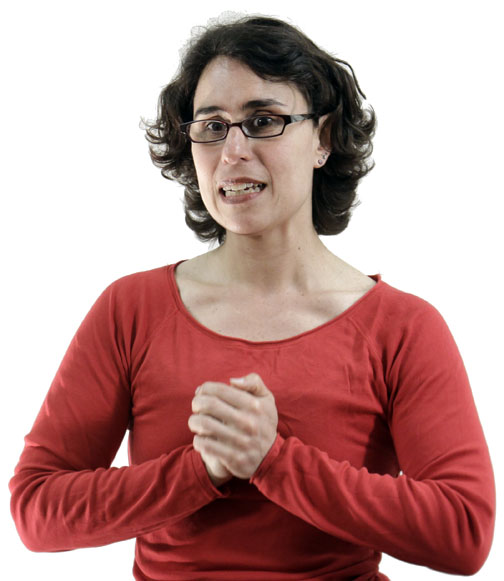 Laurie: Sometimes. We don’t do that if we can get to a needle exchange, but since we travel, it’s hard to get to a good exchange.
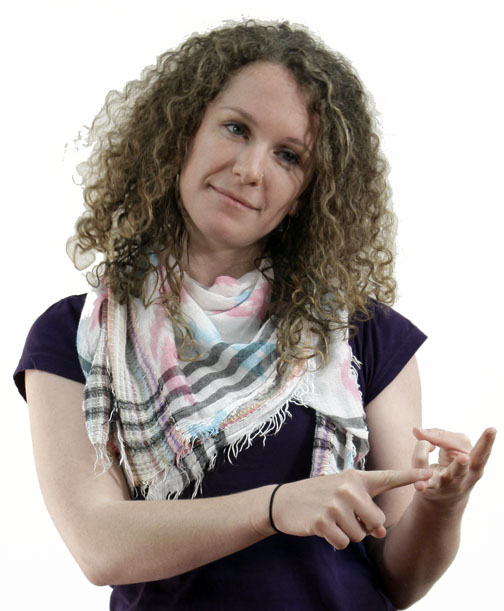 Ingrid: Are there other people, too?
Laurie: Basically just him. I mean we’ve shot up with other people sometimes, but he and I keep our stuff together. We don’t share.
Ingrid: Meaning you don’t share needles, cookers, cottons, or anything else except with your boyfriend?
Laurie: I guess sometimes when we've been high—but not usually.
Ask yourself: What is a harm reduction step Laurie could take to reduce her HIV risk?
If you’re not sure, reread screens 7–12.
Module 6: HIV, Drugs, and Injection Drug Use, Screen 13 of 14
Ingrid Considers What She Has Learned
Ingrid has learned a lot about Laurie. She knows that some of Laurie’s activities put her at high risk for HIV transmission. She has also learned that Laurie is doing some important things to protect herself.
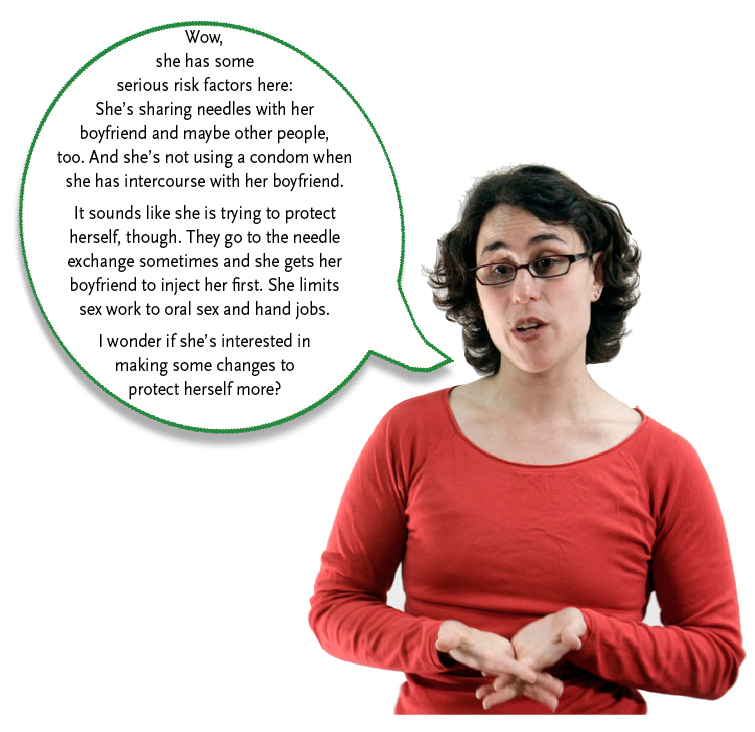
Let’s sneak a look at what Ingrid is thinking right now:
Module 6: HIV, Drugs, and Injection Drug Use, Screen 14 of 14

Conclusion
Ingrid has some great ideas for options that would reduce Laurie’s risks—everything from more lube during intercourse to urging Laurie to learn how to inject herself to brainstorming ways to increase Laurie’s use of the needle exchange.
But Ingrid knows that making one suggestion after another probably won’t work. She’s tried that before. Clients usually say, “Yes, but …” and then explain why that option won’t work for them. Both Ingrid and her client end up feeling frustrated. Ingrid knows that lecturing Laurie or trying to scare her won’t work either.
What will work?
In the next module, we’re going to explore the Stages of Change. Understanding those stages will help Ingrid have a supportive and effective discussion with Laurie about changes she might want to make.
Conclusion
Ingrid has some great ideas for options that would reduce Laurie’s risks—everything from more lube during intercourse to urging Laurie to learn how to inject herself to brainstorming ways to increase Laurie’s use of the needle exchange.
But Ingrid knows that making one suggestion after another probably won’t work. She’s tried that before. Clients usually say, “Yes, but …” and then explain why that option won’t work for them. Both Ingrid and her client end up feeling frustrated. Ingrid knows that lecturing Laurie or trying to scare her won’t work either.
What will work?
In the next module, we’re going to explore the Stages of Change. Understanding those stages will help Ingrid have a supportive and effective discussion with Laurie about changes she might want to make.