Module 8: Preparation for Test Results
| Site: | UCSF Collaborative Learning Environment |
| Course: | Advanced Counselor Skills Pre-Training Course |
| Book: | Module 8: Preparation for Test Results |
| Printed by: | Guest user |
| Date: | Friday, July 17, 2026, 2:13 PM |
Description
Module 8: Preparation for Test Results

Module 8:
Module 8: Preparation for Test Results
Module 8: Preparation for Test Results , Screen 2 of 10

Introduction
We have watched Ingrid do some effective counseling:
Laurie decided she is ready to have a conversation with her boyfriend about using condoms. On the other hand, she is not sure she wants to change anything about how she and her boyfriend use heroin. She’s going to think about that more.
Before she goes to retrieve Laurie’s test results, Ingrid needs to make sure that Laurie understands what the results will mean. That includes explaining:
Let’s watch her do that in the next few screens.
Introduction
We have watched Ingrid do some effective counseling:
- Ingrid helped Laurie feel safe enough to share experiences that put her at risk for HIV transmission.
- Ingrid explored the context of Laurie’s HIV transmission risk as well as specific activities.
Laurie decided she is ready to have a conversation with her boyfriend about using condoms. On the other hand, she is not sure she wants to change anything about how she and her boyfriend use heroin. She’s going to think about that more.
Before she goes to retrieve Laurie’s test results, Ingrid needs to make sure that Laurie understands what the results will mean. That includes explaining:
- The window period.
- The meaning of a negative test result.
- The meaning of a preliminary positive test result.
Let’s watch her do that in the next few screens.
Module 8: Preparation for Test Results , Screen 3 of 10
Ingrid Summarizes Laurie’s Talk About Change
 Ingrid: Laurie, I want to review what I heard. Please tell me if I missed anything. You are already doing important things to protect yourself from HIV: When you have sex for money, you don’t have intercourse, just blow jobs and hand jobs. Your boyfriend doesn’t like condoms, but you try to get him to withdraw before he comes. In terms of shooting up, you and your boyfriend get clean works at the needle exchange when you can, and he injects you first. You don’t share needles or works with people besides him.
 Now you’re thinking you might want to do even more. You want to talk with your boyfriend about using condoms. And you’re not sure, you need to think about it more, but you might be willing to consider changing how you shoot up. Is that right? Did I miss anything?
Laurie: That’s right. I don’t want HIV, that’s for sure. But I think I’m gonna be negative. My boyfriend tested negative last week, so that must mean I don’t have anything either.
Ingrid: It’s more complicated than that. Can I explain what I mean?
Ingrid Summarizes Laurie’s Talk About Change
Ingrid: Laurie, I want to review what I heard. Please tell me if I missed anything. You are already doing important things to protect yourself from HIV: When you have sex for money, you don’t have intercourse, just blow jobs and hand jobs. Your boyfriend doesn’t like condoms, but you try to get him to withdraw before he comes. In terms of shooting up, you and your boyfriend get clean works at the needle exchange when you can, and he injects you first. You don’t share needles or works with people besides him.Now you’re thinking you might want to do even more. You want to talk with your boyfriend about using condoms. And you’re not sure, you need to think about it more, but you might be willing to consider changing how you shoot up. Is that right? Did I miss anything?Laurie: That’s right. I don’t want HIV, that’s for sure. But I think I’m gonna be negative. My boyfriend tested negative last week, so that must mean I don’t have anything either.
Ingrid: It’s more complicated than that. Can I explain what I mean?
Module 8: Preparation for Test Results , Screen 4 of 10

Ingrid Explains HIV Antibodies
Laurie: OK.
Ingrid: Stop me if I’m saying stuff you already know. When HIV infects someone’s body, the body tries to fight it off by building antibodies, kind of like soldiers that try to fight off HIV.
 Laurie: Yeah, I remember hearing something about this.
Ingrid: What do you remember?
Laurie: That those antibodies can’t fight HIV all that well, which is why people get sick.
Ingrid: That’s right. The rapid test is looking for these antibodies. It’s looking for the body’s reaction to HIV. But it takes a while for the body to build up enough antibodies so that they will show up on the test.
Ask yourself: What is an antibody?
If you’re not sure, reread the last few screens.
Ingrid Explains HIV Antibodies
Laurie: OK.
Ingrid: Stop me if I’m saying stuff you already know. When HIV infects someone’s body, the body tries to fight it off by building antibodies, kind of like soldiers that try to fight off HIV.
Laurie: Yeah, I remember hearing something about this.Ingrid: What do you remember?
Laurie: That those antibodies can’t fight HIV all that well, which is why people get sick.
Ingrid: That’s right. The rapid test is looking for these antibodies. It’s looking for the body’s reaction to HIV. But it takes a while for the body to build up enough antibodies so that they will show up on the test.
Ask yourself: What is an antibody?
If you’re not sure, reread the last few screens.
Module 8: Preparation for Test Results , Screen 5 of 10
HIV Antibodies and the Window Period

Ingrid: Here’s something really important: If the test finds antibodies, that person very likely has HIV.
If the test doesn’t find antibodies, it means either that person doesn’t have HIV or that it just hasn’t been long enough since the person got infected for those antibodies to have accumulated enough to show up.
Laurie: Wait a second. Does that mean my boyfriend could have HIV even though he tested negative?
Ingrid: That’s true.

Laurie: Really?
Ingrid: That’s the important part: Just because he tested negative last week doesn’t mean he doesn’t have HIV. Or that you don’t. This is a lot to hear. How do you feel about this?
Laurie: Like I need to call my boyfriend right now. If this test can’t find the antibodies, then what’s the point?
Ingrid: The test is actually really good at finding antibodies. If someone has HIV, then the antibodies will eventually show up on a test. They may show up as early as two weeks after someone gets infected, but people often take longer to develop detectable antibodies. Many people with HIV show the antibodies at the end of three months. The longest it would take is six months.
Laurie: I think I follow you, but I’m not sure.
HIV Antibodies and the Window Period
Ingrid: Here’s something really important: If the test finds antibodies, that person very likely has HIV.
If the test doesn’t find antibodies, it means either that person doesn’t have HIV or that it just hasn’t been long enough since the person got infected for those antibodies to have accumulated enough to show up.
Laurie: Wait a second. Does that mean my boyfriend could have HIV even though he tested negative?
Ingrid: That’s true.
Laurie: Really?
Ingrid: That’s the important part: Just because he tested negative last week doesn’t mean he doesn’t have HIV. Or that you don’t. This is a lot to hear. How do you feel about this?
Laurie: Like I need to call my boyfriend right now. If this test can’t find the antibodies, then what’s the point?
Ingrid: The test is actually really good at finding antibodies. If someone has HIV, then the antibodies will eventually show up on a test. They may show up as early as two weeks after someone gets infected, but people often take longer to develop detectable antibodies. Many people with HIV show the antibodies at the end of three months. The longest it would take is six months.
Laurie: I think I follow you, but I’m not sure.
Module 8: Preparation for Test Results , Screen 6 of 10
The Window Period
 Ingrid: Let’s use this diagram. Sometimes it helps me understand something better if I see it. When was the last time you got someone else’s blood, cum, precum, or vaginal secretions into your body?
Laurie: Uh, we’re talking precum. So last night.
Ingrid: OK. Let’s fill this out. Today is March 4, so that would be March 3.
Ingrid: So if by any chance you got HIV last night, then the earliest you’d test positive would be in two weeks—March 17—but it could take as long as three months—June 3—or even six months—September 3. To be absolutely sure about last night, you’d need to retest around September 3.
The period of time between when someone gets HIV and when the antibodies show up on the test is called the window period. It’s called that because that is the period when the window is open for antibodies to develop and accumulate enough to be detected by the test.
The Window Period
Ingrid: Let’s use this diagram. Sometimes it helps me understand something better if I see it. When was the last time you got someone else’s blood, cum, precum, or vaginal secretions into your body?Laurie: Uh, we’re talking precum. So last night.
Ingrid: OK. Let’s fill this out. Today is March 4, so that would be March 3.
Ingrid: So if by any chance you got HIV last night, then the earliest you’d test positive would be in two weeks—March 17—but it could take as long as three months—June 3—or even six months—September 3. To be absolutely sure about last night, you’d need to retest around September 3.
The period of time between when someone gets HIV and when the antibodies show up on the test is called the window period. It’s called that because that is the period when the window is open for antibodies to develop and accumulate enough to be detected by the test.
Module 8: Preparation for Test Results , Screen 7 of 10
Why Test Now?

Laurie: Then what’s the point of me testing today?
Ingrid: It does tell you something important. If the test comes back negative today, that means that up until six months ago, you didn’t get HIV. And since your boyfriend tested negative last week, that means that up until six months ago, he didn’t have HIV either.
 Laurie: Yeah, so?
Ingrid: It’s possible that you or he could have HIV but still test negative for a few more months. That means you could pass HIV on to one another, even after testing negative, unless you protect yourselves.
There could be a silver lining to the window period. Maybe when you and your boyfriend are talking about some of the ideas you mentioned for lowering the chance of HIV transmission, you could decide to try them out for the six months of the window period. Then, at the end of six months, it might help you decide what to do next.
Laurie: Yeah, but I can’t see him going for that.
Ask yourself: What’s the earliest antibodies might show up on a test? What’s the longest? If you’re not sure, reread the last few screens.
Why Test Now?
Laurie: Then what’s the point of me testing today?
Ingrid: It does tell you something important. If the test comes back negative today, that means that up until six months ago, you didn’t get HIV. And since your boyfriend tested negative last week, that means that up until six months ago, he didn’t have HIV either.
Laurie: Yeah, so?Ingrid: It’s possible that you or he could have HIV but still test negative for a few more months. That means you could pass HIV on to one another, even after testing negative, unless you protect yourselves.
There could be a silver lining to the window period. Maybe when you and your boyfriend are talking about some of the ideas you mentioned for lowering the chance of HIV transmission, you could decide to try them out for the six months of the window period. Then, at the end of six months, it might help you decide what to do next.
Laurie: Yeah, but I can’t see him going for that.
Ask yourself: What’s the earliest antibodies might show up on a test? What’s the longest? If you’re not sure, reread the last few screens.
Module 8: Preparation for Test Results , Screen 8 of 10
Review of Negative and Preliminary Positive Results
 Ingrid: That’s definitely up to the two of you. Before I go get your results, I want to review what I told you about the possible results. OK?
Laurie: I already know. Negative means I don’t have HIV, at least I don’t have the antibodies showing today. Positive means I’ve got it.
Ingrid: That’s basically it. A negative result would mean either you don’t have HIV, or you’re in the window period and your body hasn’t yet manufactured enough HIV antibodies to show up on the test.

A preliminary positive result would mean that you very likely are infected with HIV. To be absolutely sure, we would ask for a blood sample to send to the lab and we’d ask you to return in a week for final results.
How are you feeling about all this?
Laurie: I get it. I’m pretty much talked out. I just want my results.
Ingrid: I understand. (Ingrid glances at CIF form). I just need to ask one or two quick questions for my paperwork, and then I’ll go get those results for you. Would that be OK?
Ask yourself: What does a negative test result mean? What does a preliminary positive test result mean?
If you’re not sure, reread the last few screens.
Review of Negative and Preliminary Positive Results
Ingrid: That’s definitely up to the two of you. Before I go get your results, I want to review what I told you about the possible results. OK? Laurie: I already know. Negative means I don’t have HIV, at least I don’t have the antibodies showing today. Positive means I’ve got it.
Ingrid: That’s basically it. A negative result would mean either you don’t have HIV, or you’re in the window period and your body hasn’t yet manufactured enough HIV antibodies to show up on the test.
A preliminary positive result would mean that you very likely are infected with HIV. To be absolutely sure, we would ask for a blood sample to send to the lab and we’d ask you to return in a week for final results.
How are you feeling about all this?
Laurie: I get it. I’m pretty much talked out. I just want my results.
Ingrid: I understand. (Ingrid glances at CIF form). I just need to ask one or two quick questions for my paperwork, and then I’ll go get those results for you. Would that be OK?
Ask yourself: What does a negative test result mean? What does a preliminary positive test result mean?
If you’re not sure, reread the last few screens.
Module 8: Preparation for Test Results , Screen 9 of 10

Conclusion
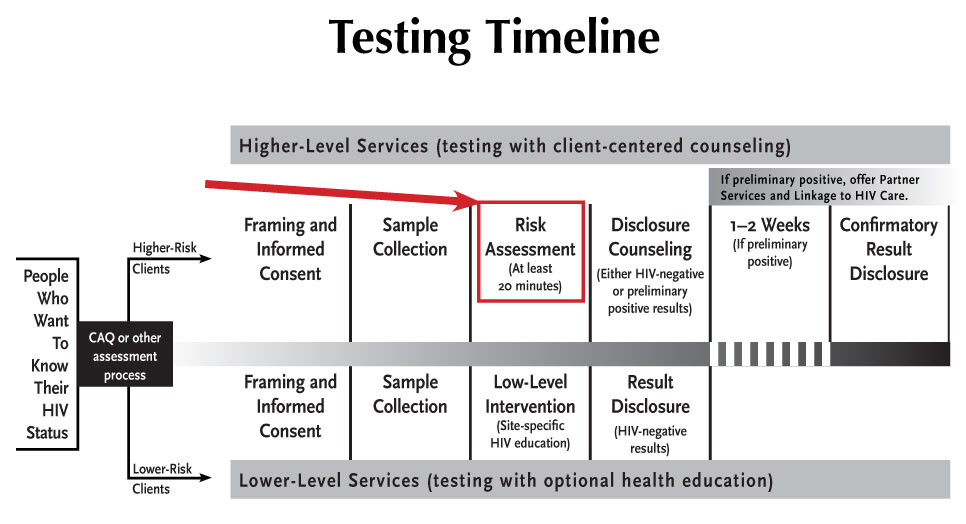
When Ingrid looks at the CIF form, she realizes that there are only two or three questions that she needs to ask Ingrid directly. Answers to most of the questions emerged naturally during their discussion. So Ingrid is just about done with the Risk Assessment section of the session.
There are only a few remaining steps:
Conclusion
When Ingrid looks at the CIF form, she realizes that there are only two or three questions that she needs to ask Ingrid directly. Answers to most of the questions emerged naturally during their discussion. So Ingrid is just about done with the Risk Assessment section of the session.
There are only a few remaining steps:
Ask any remaining questions from the CIF.
Ask if the client has questions before you retrieve the results.
Tell the client you will be gone a few minutes so the client won’t needlessly worry about how long you are gone.
Go retrieve the results.
Ask if the client has questions before you retrieve the results.
Tell the client you will be gone a few minutes so the client won’t needlessly worry about how long you are gone.
Go retrieve the results.