
1. Write a paragraph describing the extent to which an socioecological framework incorporating issues related to social determinants has been applied to your area of research. Are there opportunities for improving our understanding of or approach to disparities in your area with a greater emphasis on a socioecological framework? Consider drawing a DAG or a socioecological model (like the one shown in class for obesity) to illustrate your point (you can take a picture to post on the forum).
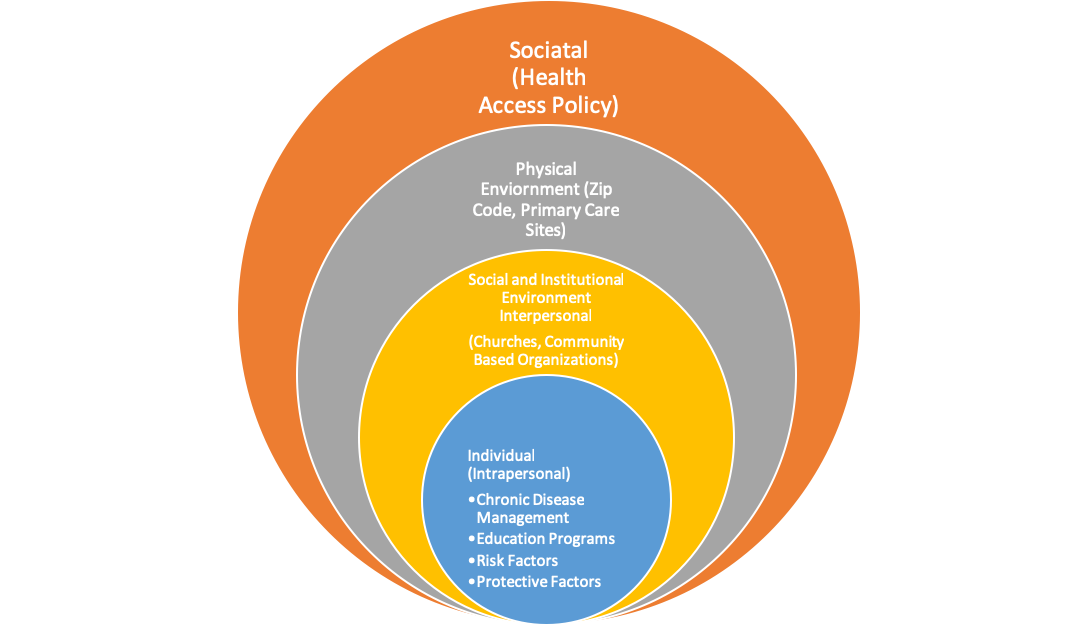
The area of research that I’m focused on is access to health care and health care utilization patterns of adults who seek care aboard mobile medical clinics. The socioecological framework incorporates issues related to health care access and utilization at all levels. The outermost ring is impacted by health policy. Particularly for those who are uninsured and unable to attain insurance. The physical environment includes place or zip code and health access disparities. Social and institutional environment would include the mobile clinic, churches and other community based organizations. The final circle is the individual who may be vulnerable with chronic disease and other risk factors.
2. In the WHO reading, the authors describe structural stratifiers (e.g. income, education, etc) and intermediary determinants such as material and psychosocial circumstances. Pick 3 of these factors (at least one structural and one intermediary). Explain why you chose the factors (might use Braveman article to provide justification) and describe how each could be an important determinant of a health outcome of your choosing. The association could be reported in published research or it could be your hypothesized relationship. Consider whether how these factors might function over the life-course and/or intergenerationally..
Structural stratifiers such as education, income along with intermediary determinants; food desert are contributors to type II diabetes in adults who do not have health insurance. According to the Braveman article income and education are good measures for SES. Studies have shown that income and education can affect health outcomes. Food desert are a concern for the population served by the mobile clinic because there is a limited number of health food options in the geographic area that the clinic provides its services. This is a concern for those who are diabetic who need healthy food choices.