
Module 5: HIV Transmission and Prevention
Completion requirements
Module 5: HIV Transmission and Prevention
Module 5: HIV Transmission and Prevention, Screen 4 of 17
Continuum of Risk
As you can see in this illustration, different activities pose different risks for HIV. If you look at the continuum, anal or vaginal intercourse with someone who has the virus risks infection much more than, say, oral sex.
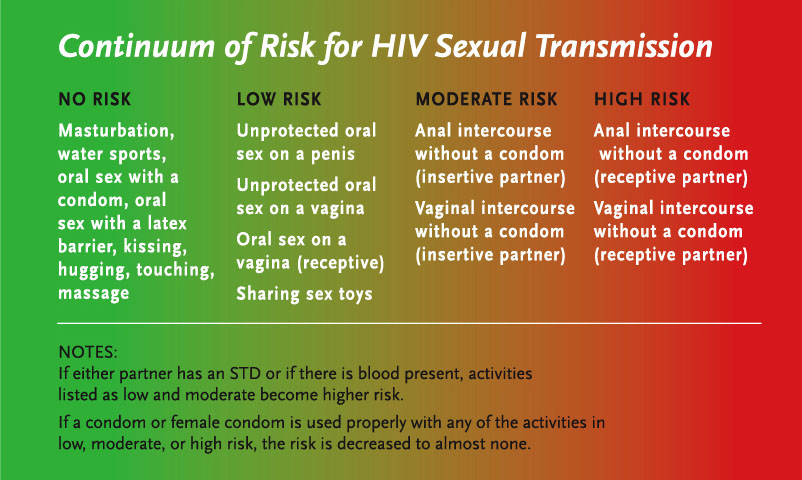
When you’re counseling, you might use the concept of a continuum of risk to help clients think of small, incremental steps to reduce the chance of infection. For example, if a client is not going to use a condom, substituting oral sex for anal intercourse is a step that dramatically reduces the client’s chance of contracting or transmitting the virus.
Let’s look at two specific examples of options for reducing the risk of HIV infection.
Ask yourself: Can you name three activities that are high risk for HIV transmission?
If you’re not sure, reread the last few screens.
Continuum of Risk
As you can see in this illustration, different activities pose different risks for HIV. If you look at the continuum, anal or vaginal intercourse with someone who has the virus risks infection much more than, say, oral sex.
When you’re counseling, you might use the concept of a continuum of risk to help clients think of small, incremental steps to reduce the chance of infection. For example, if a client is not going to use a condom, substituting oral sex for anal intercourse is a step that dramatically reduces the client’s chance of contracting or transmitting the virus.
Let’s look at two specific examples of options for reducing the risk of HIV infection.
Ask yourself: Can you name three activities that are high risk for HIV transmission?
If you’re not sure, reread the last few screens.