
1. Give an example of a research question for investigating racial/ethnic health disparities where: [1] SES is a confounder; [2] SES is an effect modifier; [3] SES is a mediator. Briefly discuss the interpretations/implications of each approach as it relates to understanding health disparities by race/ethnicity.
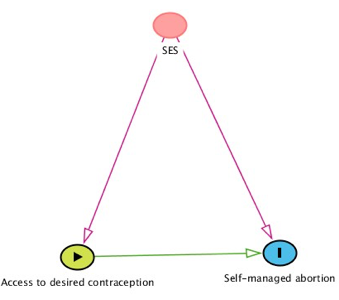
SES as Confounder: Do racial differences in access to desired contraceptives lead to different rates of self-managed abortion. Study looking at disparity in contraceptive access by race and its association with rates of self-managed abortion where low SES could be related to both less access to contraception and higher likelihood of self-managed abortion. (See DAG).
SES as Effect Modifier: Are there racial disparities in doula access? People of color may be less likely to access doula care, an effect that is modified by low SES.
SES as a Mediator: Study looking at racial disparities in postpartum cardiomyopathy. Postpartum cardiomyopathy is more common in African-Americans. Study to look at race association with postpartum cardiomyopathy with SES on the causal pathway.
2. Describe a potential effect modifier, mediator, or contextual variable (for definition of contextual variable, see Diez-Roux reading) for an association of interest to you and relevant to health disparities. For example, for investigating the association between education and hypertension, I might be interested in evaluating whether the association between years of education and hypertension is different for Black men than for White men. Describe how you would study whether this relationship exists.
I am currently studying emergency provider attitudes and knowledge around self-managed abortion. I’m interested in looking at the association between the provider’s knowledge about post-abortion care and their interest in receiving additional training around post-abortion patients. I am planning to look at whether there are differences in outcome between different training backgrounds (NP, PA, MD vs. DO) and differences in gender.