Title: Natural language processing in opioid related disorders research: a scoping review
Authors: Shivani Mehta, Kate Chirikova, Clay Carter
Structured summary:
Background
Detection of opioid related disorders (ORD) is important but challenging. Natural language processing (NLP) techniques applied to clinical notes and other kinds of unstructured data (e.g. social media, health research databases) have a great potential for identifying cases of ORD but this approach is relatively new and not widely used. This scoping review explores literature in which NLP techniques were used to identify evidence of opioid related disorders. We assess the advantages and shortcomings of this analytical approach based on the available literature.
Methods
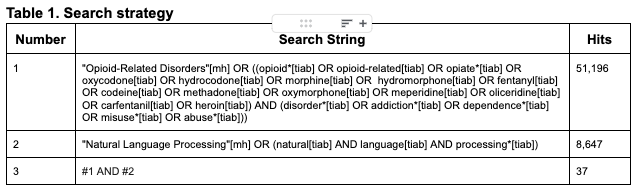
This review followed the Preferred Reporting Items for Systematic Reviews and Meta-Analysis (PRISMA) guidelines. The literature search was performed in four databases: PubMed/Medline, Embase, Web of Science, and CINAHL. Two authors screened the articles for inclusion. Articles discussing identification of ORD and application of natural language processing were included in this review.
Results - TBD
Conclusions - TBD
Introduction
Rationale
NLP is considered the mainstream approach to handle text and speech data. NLP algorithms are able to identify health outcomes through electronic medical record (EMR) clinical notes data. Semi-automated NLP methods can accurately identify evidence of opioid related disorders in vast amounts of patient-level EMR clinical notes1. Applying these scalable methods may increase surveillance and help clinicians identify patients with symptoms of opioid-related disorders1. Thus, is it vital for this scoping review to assess the landscape of NLP methods in opioid-related disorders.
The intended audience of this scoping review includes bioinformaticists, epidemiologists, and clinicians. It is expected that the findings will be useful to understand the landscape of NLP methods in opioid-related disorders. To our knowledge, this is the first scoping review of the application of NLP methods in opioid-related disorders research.
Objectives
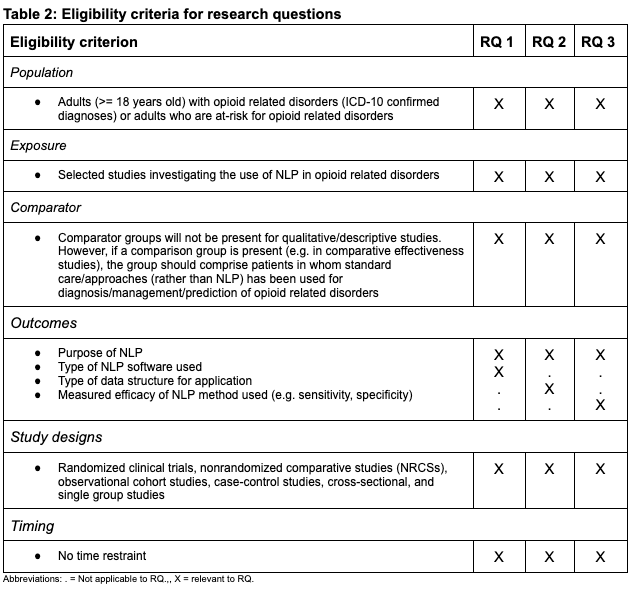
The primary aim of this scoping review was to summarize the studies where NLP had been applied to identify evidence of opioid-related disorders. We assessed the types of data (i.e., structured, unstructured, electronic medical records, social media data) and types of open-source NLP software (i.e. cTAKES, Apache OpenNLP) that have been used to implement NLP methods. Where possible, we report sensitivity and specificity of NLP methods used in the studies in comparison to the gold standard (i.e. diagnosis by a clinician).
(Edited by Sepehr Hashemi - original submission Wednesday, January 26, 2022, 6:58 PM)
(Edited by Sepehr Hashemi - original submission Wednesday, January 26, 2022, 6:58 PM)
(Edited by Sepehr Hashemi - original submission Wednesday, January 26, 2022, 6:58 PM)
(Edited by Sepehr Hashemi - original submission Wednesday, January 26, 2022, 6:58 PM)
(Edited by Sepehr Hashemi - original submission Wednesday, January 26, 2022, 6:58 PM)
(Edited by Sepehr Hashemi - original submission Wednesday, January 26, 2022, 6:58 PM)