Hi Jean,
Thank you for your thoughtful questions. Please note, Slides 16-22 of Lecture 2, part 4 were purposely labelled as "Extra Slides" bc Dr. Glymour will revisit and expand on these during her DAG's lecture on 2/7. I've also cc'd her on the exchanges the TA's and I have had about your questions, so she has a head's up.
In the meanwhile, please see comments from me and the TA's below (your questions italicized).
Best wishes.
JMC
Slide 18, prevalent users bias: in this DAG, X affects both the event prior to time 0 and the event after time 0. Thus, is this like slides 21/22 where this type of prevalent users bias only causes bias under the non-null? (Under the null, no collider exists). Here would both event rates and effect estimates be unbiased?
Comment: Yes, this only causes bias only under the non-null,
like Slide 22. Under the null, where X doesn’t affect the event neither prior
nor after T0, there is no collider bias and the effect estimate is not biased.
The descriptive measures (rates in exposed and unexposed) though will be incorrect (as
mentioned on slide 22.
Under the non-null both (rates and effect estimates)
would be biased.
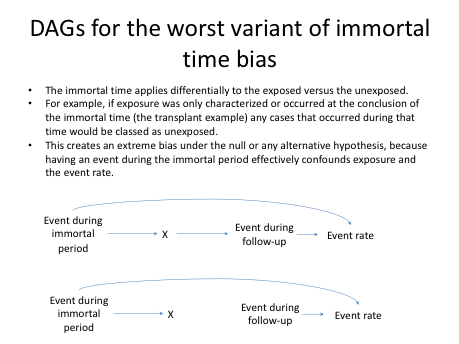
Slide 21, immortal time bias: this DAG and Maria's description seem to match Hernan's explanation of emulation failure 3 (where time 0 is set before eligibility and treatment assignment but is equal between groups). Is this also the DAG for emulation failure 4?
Comment: I agree that Emulation failure 3 aligns with slide 21. For emulation failure
4, please see comment at end.
One could argue that meeting Hernan's example of the "three aspirin prescription" exposure definition happens at the end of the immortal period, and is therefore temporally after any event during the immortal period (and couldn't be a cause of it). Are we assuming that prescription 1 of aspirin affects events during the immortal period, and that prescription 2 affects events during the immortal period, etc? Or that just requiring that they have three prescriptions influences selection but this is not mediated by events in the immortal period?
Comment: I think we are only
requiring the latter for the bias to occur - that requiring they have 3
prescriptions in 1 yr leads to bias… I think if having 1 Rx influences the
event rate during immortal PT that makes the situation more complex, but is not
necessary for there to be bias. Either scenario could lead to bias, but we were
referring to the simpler one – that requiring 3 prescriptions in 1 year means
that to be exposed you must live at least 1 year.
I was hoping for clarity on the DAG for this type of emulation failure. Hernan also notes this type of immortal time bias could be selection bias or misclassification.
Comment: I agree, this type of Immortal PT bias also seems like a flavor of selection bias.
You have raised good questions.
Last year, I asked Miguel Hernan for example DAG’s for emulation 3 and 4, and
he responded with: “I have not yet been able to find a satisfying way to
represent Failures 3 and 4, which is why DAGs were not included in the J Clin
Epidemiol paper…” When I asked Dr. Glymour her opinion, she provided the
slides which I’ve included as “extras”, which the caveat that she did not
recall seeing anyone show DAG’s for immortal person time bias before, and the
qualifier that these DAG’s were just first passes, and she welcomed feedback.
This is part of the reason for
why I put these slides under “extra”s – as I consider these more as starting
points for discussing how to graphically display/discuss immortal person time
bias, and Dr. Glymour will discuss this further in her lecture.
Hope that helps!