Sorry I'm a bit late - just got back in the country. Attached prior two submissions in case of desire to reference but new portion of protocol is below:
1. Identify a patient or community group that contributes to or is involved in the principal behavior you are attempting to improve with your intervention.
The main community group that will need to undergo behavioral change is the intraoperative staff that are responsible for OR turnover time. This includes the surgeon team, the anesthesia team, the nursing team, and the housekeeping staff.
2. Using any of the individual explanatory theories in “Theory at a Glance”, develop an explanatory model for the target behavior (above) that you will be attempting to influence with your intervention.
This intervention will be most effective at an interpersonal level, in understanding the context and environment through which these different groups of individuals interact to make a process happen (and to improve and change this process). Therefore I think theory that may be most applicable is the Social Cognitive Theory, which emphasizes how personal and environmental behaviors as well as human behavior influence each other. Three components that are highlighted as the main factors affecting the likelihood that a person will change their behavior are:
(1) Self-efficacy: this will be potentially the most important aspect of this intervention, as this is currently the area in which these groups struggle the most. Because there are so many components of OR turnover time that must occur simultaneously and in tandem, no one individual realizes their ability to achieve change or success.
(2) Goals: it will be important not only to set goals for the community, but also for the community to be involved in setting these goals. The goals must be achievable but also capable of resulting in a meaningful difference.
(3) Outcome expectancies: individuals must be held to expectations regarding outcomes of the group. Giving feedback on outcomes will also be a central component to not only setting the expectations, but then reinforcing them.
3. Identify how one or more of your specific interventions will target one or more of these key factors contributing to the behavior of interest.
The table below reflects the Social Cognitive Theory concepts, definitions, and potential strategies for change for this particular project in the third column:
|
Concept |
Definition |
Potential Change Strategy |
|
Reciprocal determination |
Dynamic interaction of person, behavior, and environment |
Identify multiple areas of potential behavior change. This will be a multi-step process involving:
|
|
Behavioral capacity |
Knowledge and skill to perform a given behavior |
Share results of other hospitals interventions/turnover times with hospital staff so that they realize that goals are obtainable |
|
Expectations |
Anticipated outcomes of a behavior |
This can be done through sharing results of turnover times publicly and also through modeling positive results, such as ORs who do this well or who make meaningful change |
|
Self-efficacy |
Confidence in one’s ability to take action and overcome barriers |
Same as above, particularly in modeling ORs that have improvement in turnover time numbers, which will hopefully help people understand that change can happen |
|
Observational learning (modeling) |
Behavioral acquisition that occurs by watching the actions and outcomes of others’ behavior |
Chose a role model such as someone who does this well – Dr. Bozic is an example of someone who has OR turnover times consistently less than 15 minutes. Show people the process by which his OR accomplishes this. Potentially allow others to rotate into or observe this process for a day or two to understand how it works. |
|
Reinforcements |
Responses to a person’s behavior that increase or decrease the likelihood of recurrence |
This will rely on providing incentives towards behavior change. These should be initiated by stakeholders to determine what reinforcements will continue to promote behavior change. |
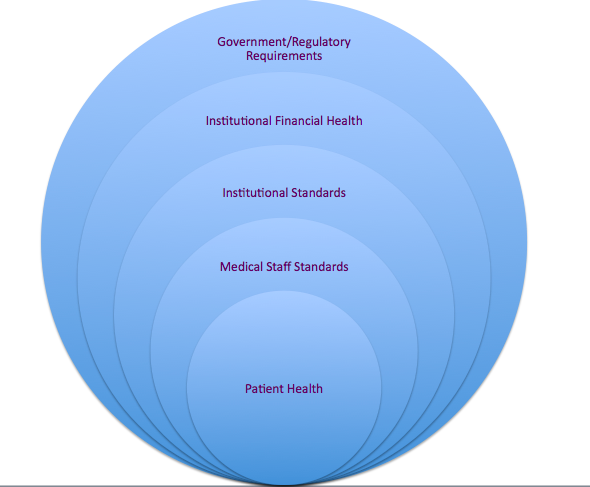
4. Create a framework that draws upon a socio-ecological framework to orient your target behavior within a larger context. ie, what are some of broader, external forces that influence the individual behavior of interest...see Figure 2 of “Theory at a Glance.”
Ultimately there are many intersecting, interacting, and overlapping external forces that place this problem into a larger context. While everything is grounded in the first priority of patient health, there are also other rules, regulations, and codes of behavior that are important. For example, nurses and physicians are trained to carry out tasks while keeping in mind standards and expected behaviors, the institution sets out rules about how tasks can and cannot be performed, the institution makes requirements based on their own health as an institution, and hospitals are also regulated by outside agencies that impose requirements as well. All of these combine to exert many external forces on all of the individuals that are involved in this process.