
EPI 207: Epidemiologic Methods II (Winter 2021)
Section outline
-
-

EPI 207 Winter 2021 (3 units)
Course Director:
-
-
-
Course Introduction & Conceptual Frameworks for Causal Inference
Introduction to the course; models/heuristics for causal inference in epidemiology; discussion of counterfactuals and identifiability criteria; ideal randomized experiments; conditional randomization
Faculty: June Chan, Rebecca Graff
-
Intro to EPI 207 W21 revised Media Resource
-
Conceptual Frameworks for Causal Inference - Part 1 Media Resource
-
Conceptual Frameworks for Causal Inference - Part 2 Media Resource
-
Bradford Hill (Optional) Media Resource
-
Sufficient & Component Cause (Optional) Media Resource
-
-
-
Two word clouds from first day of class FileUploaded 01/9/21, 12:29
-
-
-
Class Recording - Week 1 Media Resource
-
Article to Read for HW - Jain, et al. JAMA 2015 File
-
Office Hours
Instructors: Alice Guan, Eduardo Santiago-Rodriguez
-
DAGs
How to draw and use directed acyclic graphs; d-separation; DAGs to represent common biases in epidemiology; limitations of DAGs
Faculty: Rebecca Graff
-
Directed Acyclic Graphs - Part 1 Media Resource
-
-
-
Class Recording - Week 2 Media Resource
-
Article to Read for HW - Hernan, et al. Ann Neurol 2001 File
-
Directed Acyclic Graphs Homework Answer Key File
-
Office Hours
Instructors: Alice Guan, Eduardo Santiago-Rodriguez
-
Homework #1 Review: Conceptual Frameworks for Causal Inference
Instructors: Alice Guan, Eduardo Santiago-Rodriguez
-
Class Recording - Week 3 Media Resource
-
Office Hours
Instructors: Alice Guan, Eduardo Santiago-Rodriguez
-
Homework #2 Review: DAGs
Instructors: Alice Guan, Eduardo Santiago-Rodriguez
-
Target Trials
Strengths and limitations of randomized clinical trials; similarities and differences between components of randomized clinical trials and observational studies; application of using a “target trial” to make causal inferences from cohort studies.
Faculty: June Chan
-
Target Trials - Part 1 Media Resource
-
Target Trials - Part 3 Media Resource
-
-
Class Recording - Week 4 Media Resource
-
Article to Read for HW - Lawson, et al. J Natl Cancer Inst 2007 File
-
EPID 207 W21 Target Trials HW Questions FileUploaded 01/28/21, 13:42
-
210203 EPI207 RCT Coh Target Trials KEY ONLY to POST FileUploaded 02/3/21, 11:07
-
Office Hours:
Instructors: Alice Guan, Eduardo Santiago-Rodriguez
-
Homework #3 Review: Target Trials
Instructors: Alice Guan, Eduardo Santiago-Rodriguez
-
Matching in Observational Studies
Purpose of matching; matching in cohort and case-control studies; case-crossover studies
Faculty: Rebecca Graff
-
Mansournia, et al. Int J Epidemiol 2013 File
-
Pearce BMJ 2016 File
-
Dennekamp, et al. Environ Health Perspect 2015 File
-
Matching in Observational Studies - Part 1 Media Resource
-
Matching in Observational studies - Part 2 Media Resource
-
Matching in Observational Studies - Part 3 Media Resource
-
Class Recording - Week 5 Media Resource
-
-
Article to Read for HW - Poynter, et al. N Engl J Med 2005 File
-
Matching in Observational Studies Homework Answer Key File
-
Office Hours
Instructors: Alice Guan, Eduardo Santiago-Rodriguez
-
Homework #4 Review: Matching
Instructors: Alice Guan, Eduardo Santiago-Rodriguez
-
Lecture: Interaction/Effect Modification
Faculty: June Chan
BEFORE class on Feb. 11, 2021, please do the readings and view/review Parts 1-4 of Interaction/Effect Modification (listed on Feb. 11). You are responsible for the material in all parts, however note that Parts 1, 2a, and 2b may be more of a “review” for some. In particular, parts 2a and 2b may have been recently covered by Dr. Shiboski in BIO208. For these sections, you may wish to skim the slides, to ensure that you are familiar with the material but may opt not to watch the video lectures. Part 3 is a slide deck of definitions only (no video), and we will review some of this during the live lecture on 2/11. In the live lecture on 2/11, we will also be focusing on discussing interaction using the counterfactual framework.
-
VanderWeele.InteractionTutorial 2014 clean to post File
-
Part 1 Intro Interaction EffMod winter 2019 Media Resource
-
Part 2a_rec_Model Coeff_Interaction EffMod v2 Media Resource
-
Part 2b_rec_Model Coeff_Interaction EffMod v2 Media Resource
-
Part4 rec Presenting EffMod winter 2019 REDO 190227 Media Resource
-
Part 6 AFTER live lec Part 5_EPID207 W21 Intro to Interaction App by Francois Rerolle_Recorded Lec Media Resource
-
In_Class_Int EM_Updates Parts 3_4 AND Live Part5 Counterfactual Framework File
-
Part7 OPTIONAL Appendix NOT Recorded Interaction EffMod File
-
Class Recording - Week 6 Media Resource
-
EM and Interaction HW Ques W21 FileUploaded 02/11/21, 11:32
-
Dataset for Interaction HW File
-
210218 W21 Interaction HW Answ Key to POST FileUploaded 02/18/21, 17:19
-
Office Hours
Instructors: Alice Guan, Eduardo Santiago-Rodriguez
-
Lecture: Person-time and Bias (In-Person Lecture)
Fixed vs. open cohorts; the dynamic allocation of person-time in longitudinal cohorts; patient or survivor cohorts; particular bias issues discussed in the setting of patient cohorts (including selection bias, immortal-person time bias, measurement error bias, confounding by indication, and residual confounding); and how emulation of a target trial may help avoid some of these biases.
Faculty: June Chan
View Parts 1-3 of Person-time and Bias lecture BEFORE coming to class on Feb 18, 2021.
-
For those interested in a bit more background information on survival analysis, please see this chapter written by Dr. McCulloch for the UCSF medical students, in 2016. We are sharing this supplemental information with his permission. Please note there may be internal references in this chapter to other texts from that course, which are not relevant for EPI207. (citation: Ch. 65 of the UCSF SOM Mechanisms, Methods, and Malignancy syllabus, 2016, copyright UC Regents)
-
-
-
200130 InClass Exercise Ques withANSWERS File
-
Class Recording - Week 7 Media Resource
-
HW PT Bias Ques to Post W21 FileUploaded 02/18/21, 12:32
-
W21 PT Bias KEY to post File
-
Homework #5 Review: Effect Modification/Interaction
Instructors: Alice Guan, Eduardo Santiago-Rodriguez
-
Office Hours
Instructors: Alice Guan, Eduardo Santiago-Rodriguez
-
Lecture: DAGs for Advanced Challenges to Validity
Faculty: June Chan and Rebecca Graff
-
Class Recording - Week 8 Media Resource
-
Homework #6 Review: Person-Time/Bias
Instructors: Alice Guan, Eduardo Santiago-Rodriguez
-
Office Hours
Instructors: Alice Guan, Eduardo Santiago-Rodriguez
-
Quantitative Bias Analysis (QBA)
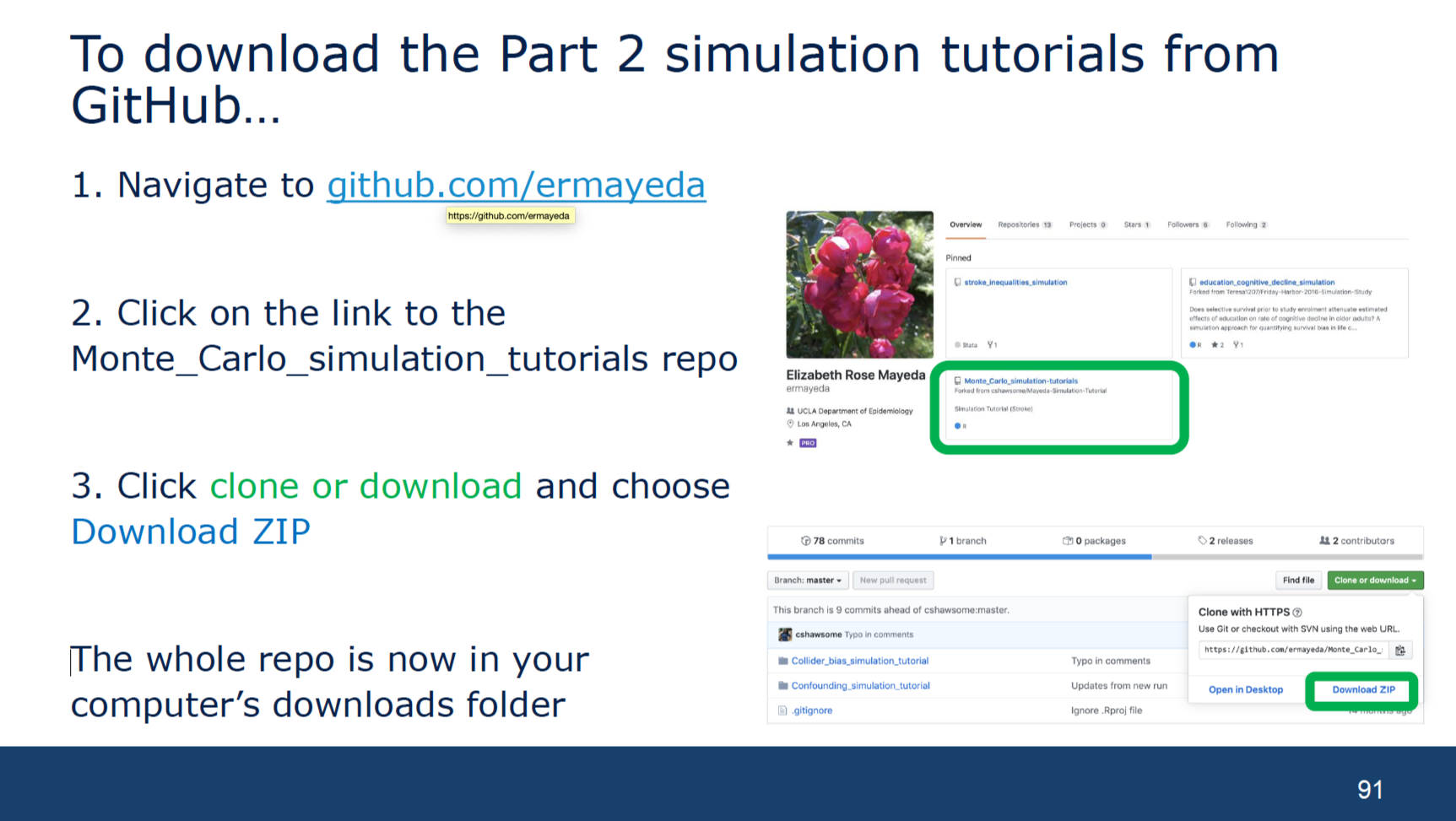
The focus of this workshop is methods for conducting quantitative bias analysis in epidemiologic research. We will first provide a brief introduction to confounding, information bias, and selection bias using causal diagrams. Next, we will discuss deterministic and probabilistic bias analysis. Dr. Mayeda will discuss examples of specific biases in her own work on determinants of cognitive decline in older adults. At the end of the workshop, participants should walk away with an understanding of the motivations behind quantitative bias analysis and how to use tools for conducting quantitative bias analysis.
The first two hours will contain the material for which students in EPI207 are responsible; the last hour is optional for the class.
Faculty: Elizabeth Rose Mayeda
-
-
-
Mayeda ER, et al. A simulation platform for quantifying survival bias: an application to research on determinants of cognitive decline. American Journal of Epidemiology. 2016 Sep 1;184(5):378-87. File
-
Hernán MA, Hernández-Díaz S, Robins JM. A structural approach to selection bias. Epidemiology. 2004;15(5):615-625. File
-
Fox MP, Lash TL, Greenland S. A method to automate probabilistic sensitivity analyses of misclassified binary variables. International journal of epidemiology. 2005;34(6):1370-1376. File
-
Last TL, et al. Good practices for quantitative bias analysis. International Journal of Epidemiology. 2014;43(6):1969-1985. File
-
-
Class Recording QBA Workshop W21 Media Resource
-
Orsini article for QBA HW File
-
QBA Homework Answer Key File
-
-
Office Hours
Instructors: Alice Guan, Eduardo Santiago-Rodriguez
-
Homework #7 Review: QBA
Instructors: Alice Guan, Eduardo Santiago-Rodriguez
-
Wrap Up
Faculty: June Chan, Rebecca Graff
-
Emilsson et al JAMA 2018 Bias in Studies of Statins and Cancer URL
-
Chan et al JAMA 2018_Commentary Statins & Overall and CA survival URL
-
Stefan MS Orig Article JAMA 21 Antibiotics and Asthma with potential IM Time bias URL
-
Newman T Comment on Stefan MS_JAMA 21 IM Time Bias_Antibiotics_Asthma URL
-
Stefan MS et al JAMA 21 Retraction and Replacement URL
-
-
-
Class Recording Wrap-up / Review Media Resource
-
The final exam will be posted by 5:00pm on Thursday, 3/11 and be due by Friday, 3/19 at 11:59pm.
-
2021 Epi 207 Final Exam Questions v2 FileUploaded 03/17/21, 08:52
-
Satia, et al. Am J Epidemiol 2009 (Q1-Q4) File
-
Jain, et al. JAMA 2015 Supplement (Q8) File
-
RIVUR Dataset (Q9) File
-
2021 Epi 207 Final Exam Answer Key FileUploaded 03/18/21, 22:43